Why GCP Serverless Docker Is the Most Efficient AI Agent Compute Stack
I run multiple autonomous AI agents in production — not in a demo environment, not behind a waitlist — actually in production, handling real clients and real money. The compute architecture powering all of them is GCP Cloud Run with containerized Docker images. Here is exactly why that decision was right, and what enterprise engineers building AI systems in 2026 should understand before they reach for the wrong tool.
The Problem With "Just Use a VM"
When most engineers first think about running AI agents, the instinct is comfortable infrastructure: a VM, a Kubernetes cluster, maybe a managed GPU instance. That muscle memory is deeply wired in enterprise teams. But AI agents are not long-running monolithic services — they are event-driven, bursty, and unpredictably concurrent. They wake up, do intelligent work, and go back to sleep.
Provisioning persistent compute for that pattern is like leaving your car running at the curb all day because you might need to drive somewhere.
In large enterprise engineering organizations, I've watched this mistake play out at enormous cost — not because the engineers were wrong, but because the tooling assumptions were stale. The AI era demands a fundamentally different infrastructure philosophy.
"The AI era demands a fundamentally different infrastructure philosophy — and most enterprise teams are still building with the assumptions of the last decade."
Enter GCP Cloud Run: Serverless Containers Done Right
Cloud Run gives you the best of both worlds: the portability and reproducibility of Docker combined with the cost efficiency and elastic scale of serverless. You define your agent's runtime environment in a Dockerfile, push the image to Google Artifact Registry, and Cloud Run handles the rest — scaling from zero to concurrent requests and back to zero. No cluster management. No node pools. No capacity planning spreadsheets.
# Agent runtime — lean, reproducible, portable
FROM node:22-slim

WORKDIR /app
COPY package*.json ./
RUN npm ci --omit=dev

COPY dist/ ./dist/

ENV NODE_ENV=production
EXPOSE 8080

CMD ["node", "dist/server.js"]
Each agent lives in its own Cloud Run service. When a trigger fires — a Firestore document write, a Pub/Sub message, a Twilio webhook, a scheduled cron — Cloud Run spins up a container instance, processes the event, and releases the resources. You pay for compute-seconds, not idle time.
The Production Architecture
Below is the actual architecture powering this system in production. Specialized AI agents — covering operations, sales, engineering support, billing, and project management — each run as an isolated Cloud Run service with its own trigger surface, memory allocation, and schedule.
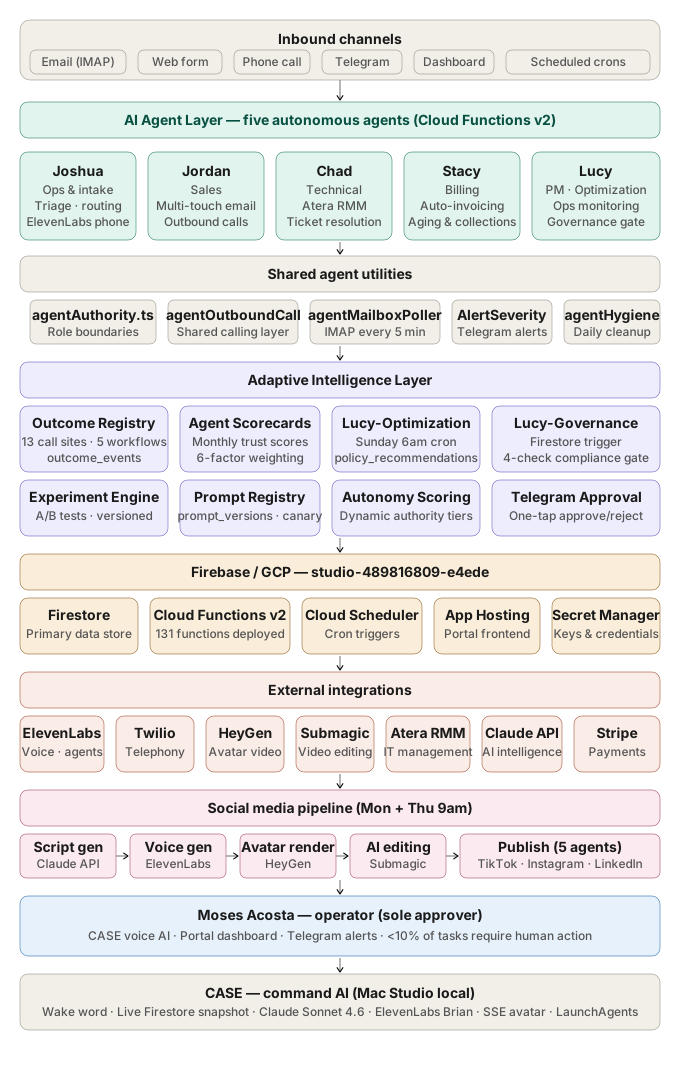
What matters architecturally: none of these agents run on shared infrastructure. Blast radius is contained by design. A misconfigured billing run does not take down inbound sales processing. A faulty scheduled task in one service does not affect voice webhook handling in another. Isolation at the container level is not just a best practice — it's a safety requirement when agents are authorized to take real-world actions.
Why This Pattern Beats the Alternatives
vs. Always-On VMs or Kubernetes
A VM running 24/7 for an agent that executes for ~40 minutes per day is a 97% waste ratio. Cloud Run's scale-to-zero means you pay for exactly what runs. At the agent density I'm running, this translates to over 80% cost reduction compared to equivalent always-on compute. Kubernetes adds value when you need fine-grained scheduling and stateful workloads — not for stateless, event-driven AI functions.
vs. Cloud Functions (Lambda-style)
Serverless functions are excellent for simple triggers but break down quickly for AI agents. Cold starts become a UX problem when a human is waiting on a response. Docker containers on Cloud Run allow you to tune minimum instances — keeping one warm instance for latency-sensitive paths while still auto-scaling for burst workloads. You also get consistent runtime environments, no function-size limits, and the ability to run long-running processes.
vs. Managed AI Platforms
Platforms like Vertex AI and SageMaker are built for model training and batch inference — not for the glue logic that makes agents actually useful: the database reads, the API calls, the CRM updates, the voice webhooks. Routing operational agent logic through a managed ML platform adds cost, latency, and unnecessary abstraction. Your agent runtime belongs in a container.
Safety Is an Architecture Decision
Infrastructure efficiency is necessary but not sufficient. When AI agents have authority to take external actions — place calls, send emails, modify records — you need defense in depth baked into the architecture itself, not bolted on as application logic. This system runs multiple safety layers including supervised approval modes for new agent capabilities, automated circuit breakers that halt operations when anomaly thresholds are crossed, authority boundary definitions that determine what each agent can resolve autonomously versus what escalates to human review, and consolidated alert systems that reduce noise to only what actually requires attention.
The key design principle: safety layers live at the infrastructure level, not just in the application code — so they cannot be bypassed by a bad deploy or an unexpected prompt path.
What This Teaches Me About Enterprise AI
I'll be direct: the most valuable thing about building this production system on the side is not the business output — it's the speed of feedback loops that no enterprise environment can match. In a large institution, shipping an AI agent from concept to production takes months of governance, review cycles, and infrastructure procurement. Here, I measured that same gap in hours.
That lived experience is exactly what makes an effective enterprise AI leader. I don't theorize about agent architectures — I've debugged them at 11pm, rebuilt safety layers after incidents, and watched cost curves in real time. The GCP serverless container pattern refined in this environment is directly applicable to enterprise scale: the principles around isolation, event-driven triggers, and layered safety translate directly, even if the governance wrapper is heavier.
"The engineers who will lead enterprise AI transformation are the ones who already have production scars — not from a sandbox, but from real systems running real workloads."
The Framework, Distilled
If you're building AI agent infrastructure, here is the architecture that works:
- One container per agent. Isolation by default, not as an afterthought.
- Cloud Run for the agent runtime. Scale to zero — pay for execution, not existence.
- Firestore as the shared state layer. Agents communicate through data, not through direct calls to each other.
- Pub/Sub for async triggers. Decouple the producers from the consumers.
- Safety layers at the infrastructure level — so they cannot be bypassed by application logic.
These patterns — event-driven microservices, immutable deployments, observability-first design — are mature. What's new is that the services are now reasoning, not just executing. That one change raises the stakes on every architectural decision.
The engineers and leaders who understand the compute substrate of AI agents — not just the model APIs sitting on top — will be the ones who shape what the next five years of enterprise technology actually looks like.
I intend to be one of them.